

Schema Drafts
Stage, review, and publish batches of schema changes — fields, mappings, and identity key ranks — together.
Drafts, previously named Schema Patches, are managed through the
/schema/patchendpoints in the API, so this page uses "patch" when describing API resources and payloads.
Introduction
Schema Drafts are how you make schema changes in Lytics. Instead of editing one field at a time against the live schema, you stage fields, mappings, and identity key ranks into a single changeset — a draft — preview a complete diff against your live schema, and publish everything at once.
When a draft is applied, it creates a new published schema version. If anything goes wrong, you can revert to a previous version using the standard schema version history.
When to Use Schema Drafts
Use a draft when you want to:
- Onboard a new data source — add the fields and mappings that belong together and roll them out as a single reviewed change.
- Reorganize identity resolution — adjust identity key ranks alongside related field changes.
- Coordinate with a team — give each changeset a tag and description so reviewers know what it's for, and let multiple people work on separate drafts at once.
- Review before anything goes live — inspect a property-level diff of every change against the live schema, so nothing reaches the live schema without an explicit apply step.
Enabling Schema Drafts
Schema drafts are available to every account, but the workflow has to be turned on before you can use it in the UI. Until it's enabled, schema edits made in the UI go through the legacy draft-based editor.
An administrator turns the workflow on from Building Profiles → Schema → Drafts using the Enable button. Users without permission to edit account settings will need to contact their administrator to enable the feature.
Before enabling, note that:
- It's an account-wide switch. Once enabled, every schema change made in the UI — for all users on the account — goes through a draft. The legacy draft editor is no longer available, and direct links to the old create and edit screens redirect into the draft workflow.
- In-progress changes carry over. You don't need to publish or discard anything first — if the account has unpublished schema changes in the legacy editor, enabling the workflow automatically converts them into a draft. Nothing is lost: open the new draft to review, edit, or apply those changes whenever you're ready.
In rare cases the automatic conversion can't complete. If that happens, you'll see a message asking you to publish or discard your unpublished changes yourself and try enabling again. Your existing changes are left intact, so it's safe to retry.
Enabling drafts changes how everyone on the account edits the schema, so plan to switch over when your team is ready to adopt the draft workflow together.
How Schema Drafts Work
The schema draft lifecycle has five steps:
-
Create a draft — Each draft targets a specific table (e.g.,
user) and starts as an empty container for your proposed changes. Until you name it, the draft is identified by a date-based placeholder such as Draft created Aug 18, 2026. -
Add changes — Add, modify, or mark for deletion any combination of fields, mappings, and identity key ranks within the draft. You can make as many changes as needed before moving forward.
-
Review the diff — Inspect the draft to see exactly what would change relative to the live schema, with property-level before/after values for every modified field and mapping, so you can verify each change before it goes live.
-
Apply the draft — When you're satisfied, apply the draft. Applying requires a tag — a short summary of the change, like a commit message subject — along with an optional longer description; both are recorded on the new schema version this publishes. From this point forward, incoming data is processed against the updated schema.
-
Revert if needed — If the applied changes cause issues, use schema version history to revert to a previous version.
You can update a draft as many times as needed before applying it, and set its tag and description at any point — up front from the draft's details drawer, or when you apply. You can also delete a draft entirely if you decide not to proceed.
Accessing Schema Drafts
From the Lytics navigation, open Building Profiles → Schema → Drafts. The list shows every draft in the account with its target table, description, creator, and timestamps. Drafts that haven't been given a tag yet appear with an italicized date-based placeholder (e.g., Draft created Aug 18, 2026). You can filter by table and sort by any column.
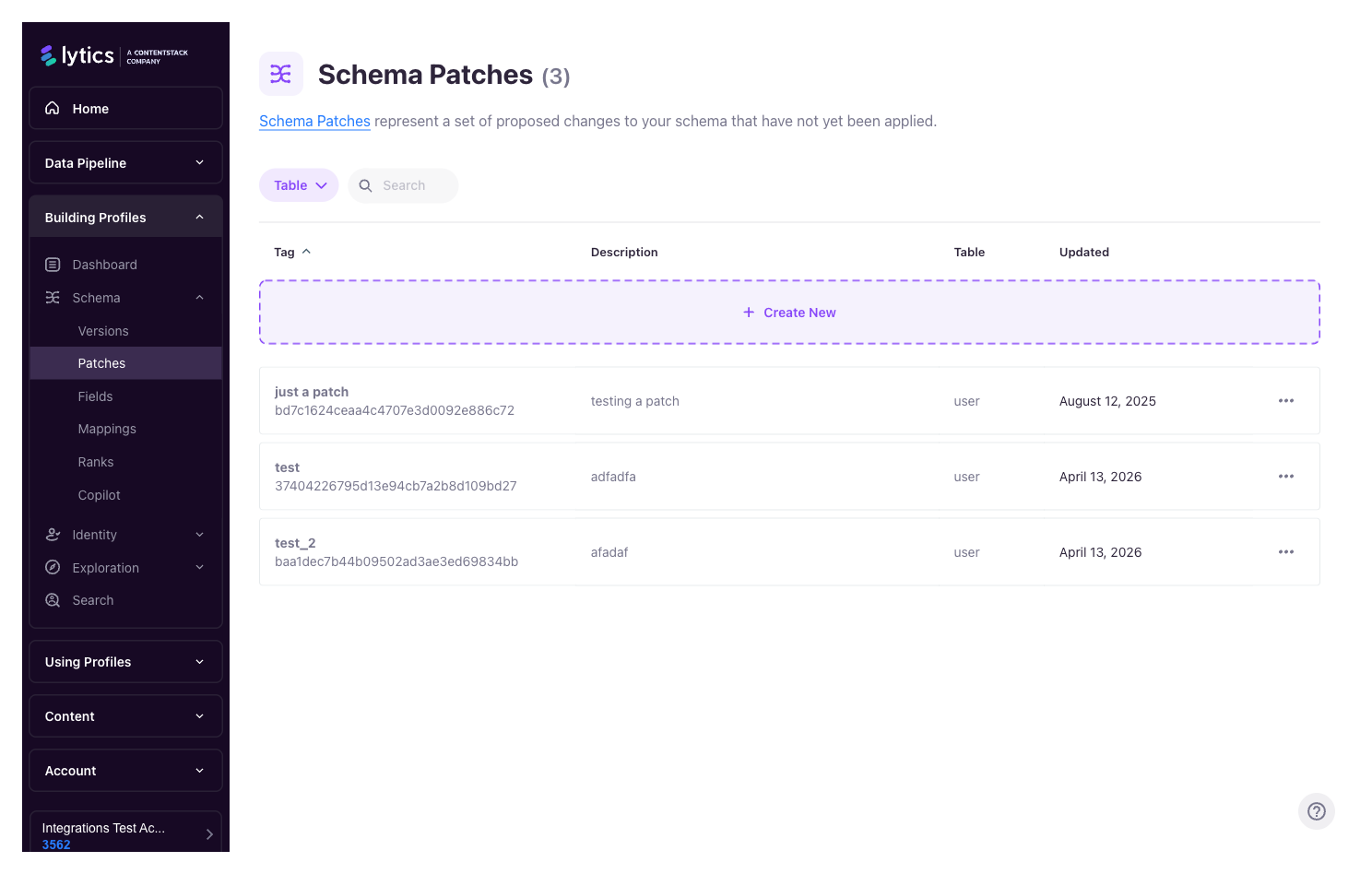
From the list you can:
- Create a new draft — choose the table it targets (e.g.,
user) and land directly in the draft editor. - Open an existing draft — continue editing a draft someone started earlier.
- Delete a draft — discard a staged changeset you no longer need. You can also delete a draft from inside the editor (see Naming a draft).
The Draft Editor
Opening a draft takes you into a two-step wizard — Edit Schema → Review & Publish — across the top of the page. The core work happens in the Edit Schema step, which is organized into tabs:
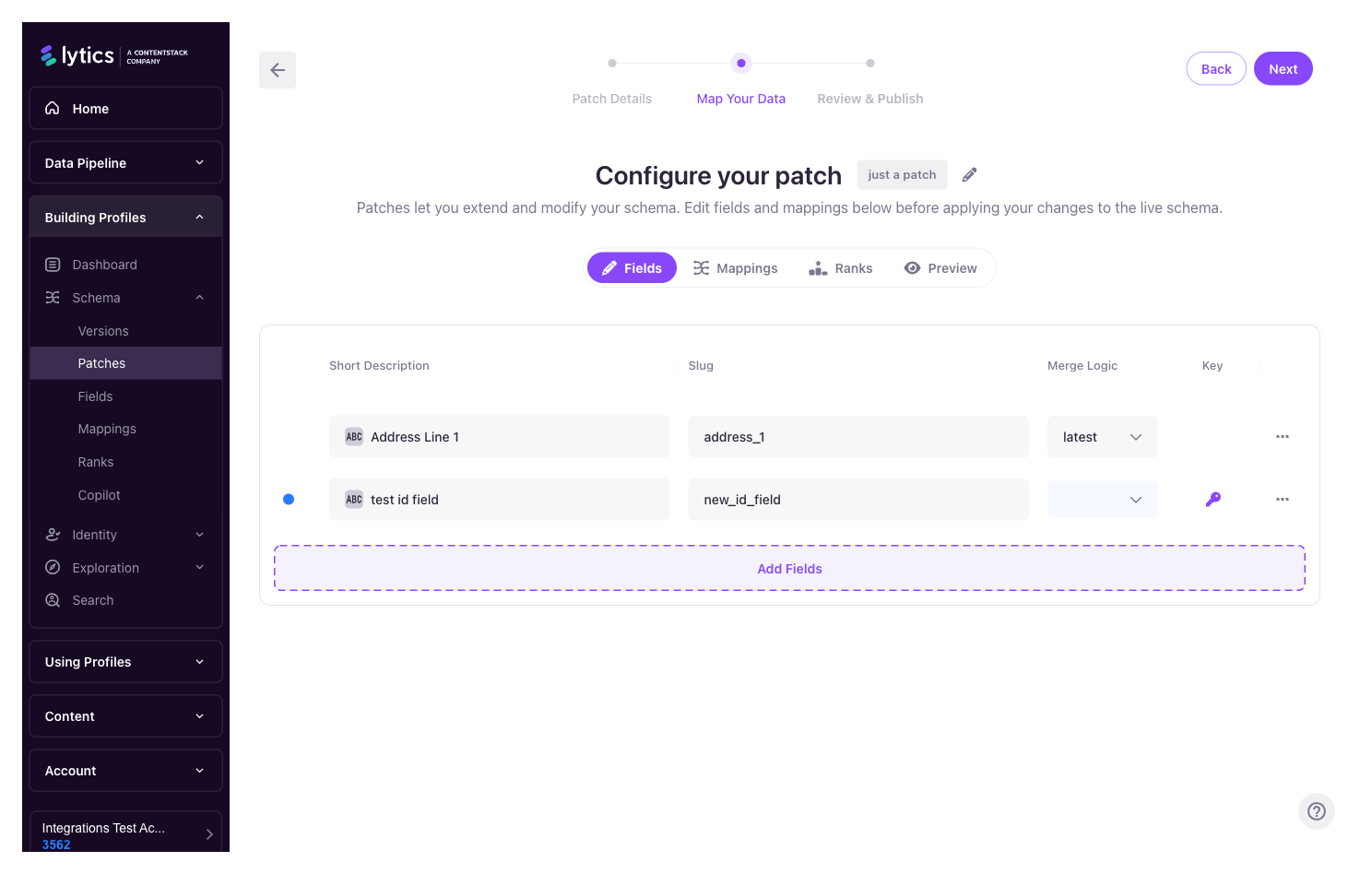
| Tab | What it's for |
|---|---|
| Fields | Add new fields, edit existing ones, or mark fields for deletion. Inline controls for data type, description, merge operator, capacity, keep days, and the other properties described in Fields & Mappings. |
| Mappings | Add or modify LQL mappings that transform incoming stream data into user fields. |
| Ranks | Reorder identity keys to change the priority used during profile resolution. See Identity Key Ranks. |
| Preview | A side-by-side diff of the draft against the live schema — every property that would change, with before/after values. |
| Try it | Run sample events through the draft merged onto the live schema and see the resolved profile before publishing. See Testing a Draft. |
| Advanced | A raw JSON editor for the draft, for power users. Access to this tab is permission-gated, so it only appears for users with the required role. |
Naming a draft
The editor header shows the draft's tag — or its date-based placeholder if it hasn't been named. Click the pencil icon next to it to open the Draft Summary drawer, where you can set or edit the draft's tag and description alongside its table, ID, and timestamps. The tag is free-form text up to 264 characters. Clearing the tag reverts the draft to its placeholder name.
The Delete draft button at the bottom of the drawer deletes the draft after you confirm, and returns you to the drafts list.
Naming a draft here is optional — if you skip it, you'll be asked for a tag when you apply the draft.
Working with Fields and Mappings
Within the Fields and Mappings tabs, each item carries an edit status that describes how it relates to the live schema:
| Status | Meaning |
|---|---|
new | Added in this draft — does not exist in the live schema. |
modified | Exists in the live schema, but one or more properties have changed. |
deleted | Marked for removal — will be deleted when the draft is applied. |
unmodified | Shown for context only. No changes from the live schema. |
When adding or updating a field, the same properties apply as when managing fields directly — data type, merge operator, capacity, keep days, and so on. See Fields & Mappings for details on field and mapping properties.
A mapping's Stream can't be changed once the mapping exists. To move a mapping to another stream, delete it and create a new one on the stream you want.
If you delete the only mapping to an identifier field on a stream, a Last Identifier for Stream dialog asks you to confirm. A stream without an identifier mapping can't attach its events to user profiles, and the draft can't be published until you add another one. Click Delete Anyway to proceed, and add a new identifier mapping before publishing.
Adding existing items to a draft
To modify a field or mapping that already exists, use Manage Fields or Manage Mappings at the bottom of the grid and choose Add Existing. Results can be filtered by type, identifier, stream, and category. Editable items surface first; non-editable items (e.g., system fields) are shown but cannot be selected. Use Select All to pull a whole filtered set into the draft at once.
"Add related" shortcuts
Click a field in the draft to jump into the mapping selector, pre-filtered to mappings that use that field. Click a mapping to find the field it writes to. This makes it straightforward to build complete, self-consistent changesets.
Undoing a change
Each item in the draft can be reverted independently without discarding the rest of the draft. For example, if you've added three fields and decide one of them isn't ready, remove that one field's changes and keep the other two.
If you don't set a
managed_byvalue when adding a field or mapping to a draft, it defaults to the current user.
Identity Key Ranks in a Draft
Identity key rank lists — which control the priority ordering of identity keys used during profile resolution — can also be staged in a draft, from the Ranks tab. Bundling rank changes alongside field and mapping updates ensures everything is reviewed and applied together.
See Identity Key Ranks for more on how rank ordering affects identity resolution.
Previewing a Draft
The Preview tab is the gate between "staged" and "published." It shows:
- Every field, mapping, and rank change in the draft, grouped by type.
- Property-level before/after values for modified items.
- Status pills on each item (
Added,Modified,Deleted) so you can scan the shape of the change at a glance.
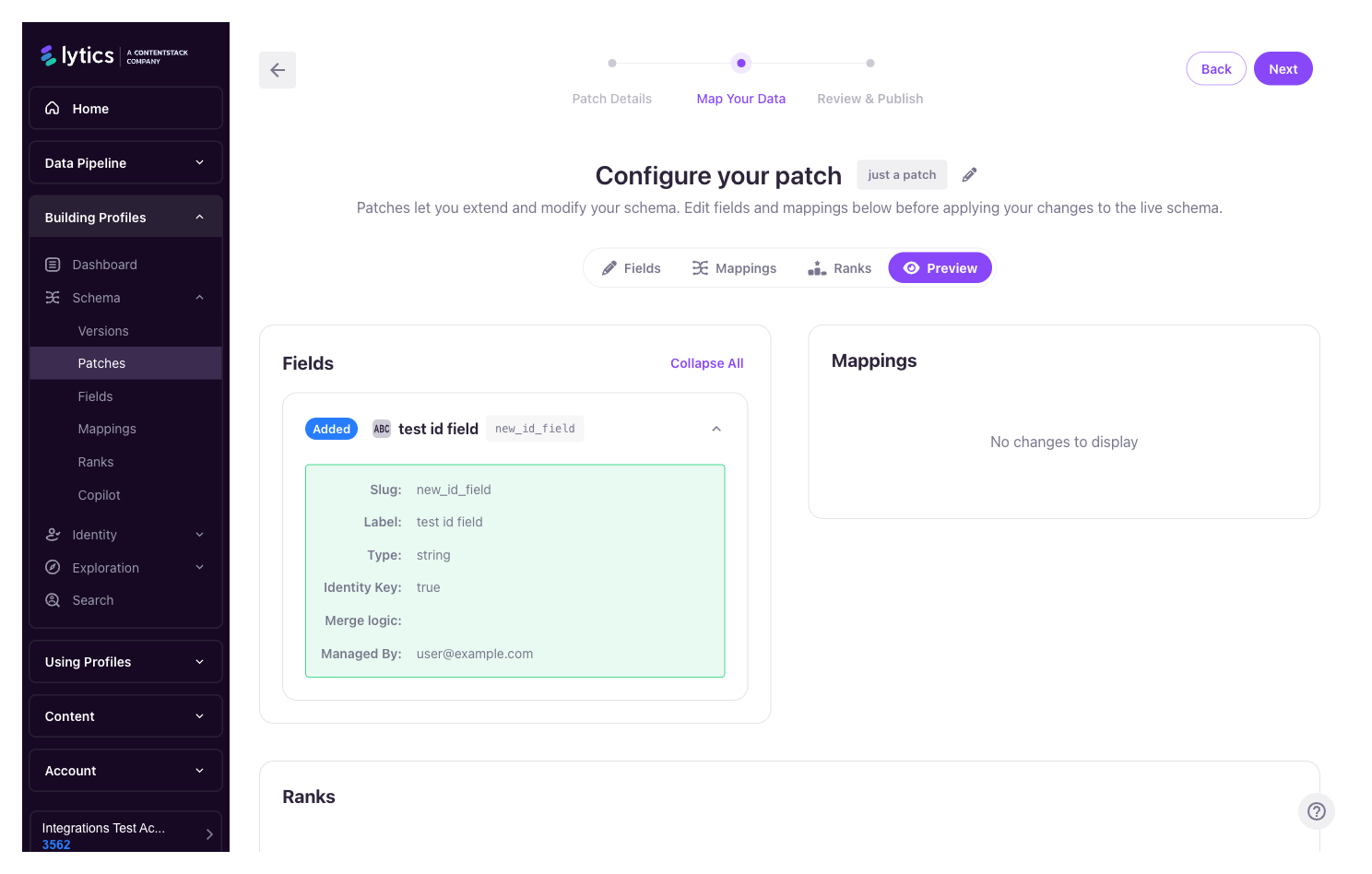
Nothing in this tab affects the live schema — it is purely a read-only review surface.
Testing a Draft
The Try it tab runs sample events through the draft as if it were already published, so you can check what a mapping produces before you apply it.
- The stream selector is pre-filled from the draft's own mappings. You can also type a stream the mappings target that doesn't exist in the account yet.
- Enter events as one JSON object per line, or click Load events to pull up to 5 recent events for each selected stream that has data.
- Run test posts the events under each selected stream to
POST /v2/schema/{table}/evaluate?patch_id=<draft id>. The draft is merged onto the live schema with the same logic publishing uses, and the resolved profile(s) are shown as JSON. - A draft with no mapped identifier returns an inline error instead of a profile. Running a test never writes to the live schema or to any profile.
Publishing a Draft
When you're satisfied with the preview, apply the draft from the Review & Publish step. The apply dialog asks for:
- Tag (required) — a brief summary of the schema changes, up to 264 characters. If the draft already has a tag, it's pre-filled; otherwise you supply one here.
- Description (optional) — a longer explanation of the change.
Applying creates a new schema version — carrying the tag and description — that contains all of the draft's changes, and incoming data is processed against the updated schema from that point forward.
A draft with no changes can't be applied: the Apply button is disabled with a "There are no changes to apply" notice until the draft contains at least one change.
If something goes wrong after publishing, revert to a previous version using the standard schema version history — no need to manually undo each change.
Drafts that target the
contenttable publish immediately on apply, without a separate review step. User-table drafts follow the full stage → preview → publish workflow.
Managed Workflows and Drafts
For accounts with drafts enabled, LQL workflows that need to modify the schema (for example, managed integrations that add new fields as they discover them in incoming data) will create a draft for you to review, rather than writing the changes straight into the schema. You'll see these drafts appear in the list with an identifying tag; open, review, and publish them as you would any manually-created draft.
Permissions
- Create / edit a draft — requires the
schema:editpermission. - Delete a draft — requires the
schema:deletepermission, from both the drafts list and the Draft Summary drawer. - Enable drafts for the account — requires permission to edit account settings.
- Advanced tab (raw JSON) — separately gated for power users.
Related
- Schema Versions — Publishing and reverting schema versions
- Fields & Mappings — Managing individual fields and mappings
- Identity Key Ranks — Identity key ranking and priority
Updated 6 days ago